 Build my stack
- outbid.lol is a public leaderboard where rank equals total money paid: $5 floor, $17,000 for #1 as of August 26, 2026.
- Built in three hours by Jonathan Wilke (supastarter.dev), it took $21,499 in bids on day one and $220,842 in a week with 1.36M visitors.
- Real receipts: CrowdReply turned $12,700 into 1,800 signups; Outrank's $12,000 needed only an 11% trial conversion to break even; MakerThrive turned $42 into a $29K day.
- Two boards matter: all-time (permanent status) and Today (24-hour rental at a quarter of the price). Category crowns start at $45.
- Zero SEO value, no refunds, attention already cooling. Buy it as a moment with pre-committed math, or skip it.
outbid.lol is a public pay-to-rank leaderboard launched on August 19, 2026, where a product's position is decided entirely by the total money bid: spots start at $5, the top spot cost $17,000 as of August 26, and the site processed $220,842 in bids from 1.36 million visitors in its first week. Built in three hours by German developer Jonathan Wilke.
On August 19, 2026, at 11:08 PM Central European Summer Time, a German developer named Jonathan Wilke pushed a website live. He had spent roughly three hours building it. The site had one feature and one sentence of pitch: pay money, rank higher.
Within 24 hours it had collected $21,499 in bids. By hour 48 it had passed $120,000 and one million visitors, enough traffic to break his analytics provider. By hour 77, independent trackers logged about $178,000. When we pulled the live counters for this piece on August 26, the homepage showed $220,842 in total revenue, 1,358,294 visitors, and 1,570 listings fighting for position.
The site is called outbid.lol, and it became the most argued-about marketing experiment of the summer. Some founders call it genius distribution theater. Others call it a slot machine with extra steps. Both camps are partly right, and this piece breaks down exactly how it works, what the buyers actually got for their money, and whether a bid makes sense for you.
A brutally simple pay-to-rank auction that turned founder FOMO into $220K in seven days. Spectacular at creating a moment, weak at creating an asset.
Funded teams selling high-ticket tools to founders, and small bettors who want a cheap story worth posting
Pre-revenue products, anyone needing compounding or SEO value, and teams that cannot afford to lose the whole bid
What Is outbid.lol?
outbid.lol is a public leaderboard where position is decided purely by money. You enter your product URL (or just an X handle), you name a dollar amount, and your listing appears at whatever rank that amount can claim. It stays there until someone pays more than your running total. Then you slide down, and the choice is yours: add funds and climb back, or accept the demotion.
That is the entire product. There are no ads on the site, no revenue sharing with listed companies, no review or moderation process, and no API integration required. A new spot starts at five dollars. The current number-one position trades above seventeen thousand.
No ads, no API keys, no revenue sharing. Just outbid your competition to get to the top.The entire pitch, from outbid.lol itself
Think of it as an eBay auction where nobody ships anything. The prize is not an object, it is attention: every listing displays a description, a running bid total, and a public click count. Visitors scroll the board like a stock ticker of startup ego, and founders watch their positions the way traders watch candles.
It helps to be precise about what it is not. It is not a directory with editorial curation. It is not a backlink scheme, despite what some early threads claimed, because the domain is weeks old with essentially zero authority to pass. And it is not a marketplace, because nothing changes hands except money for placement. It is an auction for visibility, full stop.
The Origin Story: Three Hours on a Wednesday Night
Jonathan Wilke is not a random hobbyist. He is the developer behind supastarter.dev, a well-known SaaS starter kit for Next.js and Nuxt, which means he had already shipped payment flows, leaderboards, and realtime UI many times before. outbid.lol was a side project he assembled in a single evening using that muscle memory.
He wired payments through Polar, put a live revenue counter directly on the homepage, and launched quietly at 11:08 PM. The About page reads like a victory lap written in real time. A few of the entries on it, verbatim from our August 26 screenshot below: the traffic broke his original analytics provider and he had to switch services overnight. Someone offered $100,000 to buy the site. At least ten copycats appeared within the first day.
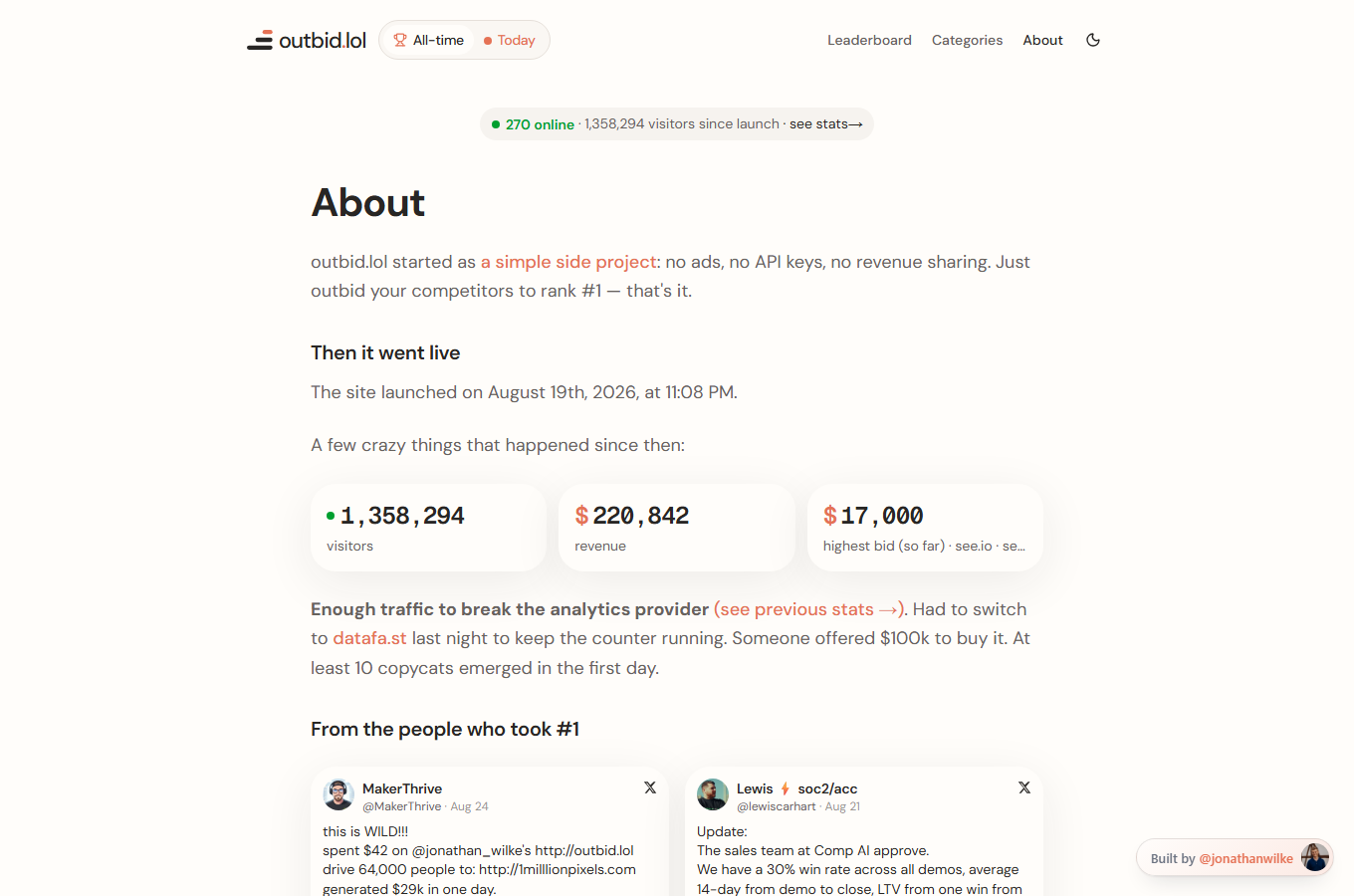
The speed matters more than it looks. When infrastructure gets cheap enough that a payment-gated, publicly-auditable auction takes one evening to build, launch mechanics mutate fast. The clone wave that followed (more than a hundred boards within a week, one tracker counted 170 live and dead) is direct evidence of that.
How outbid.lol Actually Works
The mechanics take two minutes to learn. Here is the complete flow, followed by the details most coverage skips.
- Enter your product URL or @handle. Companies and personal brands share the same board, and there is a People and Profiles category for individuals.
- Name your amount. Five dollars is the floor for a new listing. If your domain is already on the board, a new payment adds to your cumulative total instead of creating a duplicate.
- Pick one of 29 categories. Your bid competes globally on the main board and separately within your category, so a modest bid can still own a niche crown.
- Pay through Polar. Rankings update in real time across everyone's browser.
- Watch your clicks accumulate. Every listing exposes its click count, which is the closest thing to measurable ROI the platform offers.
The two-board system almost nobody mentions
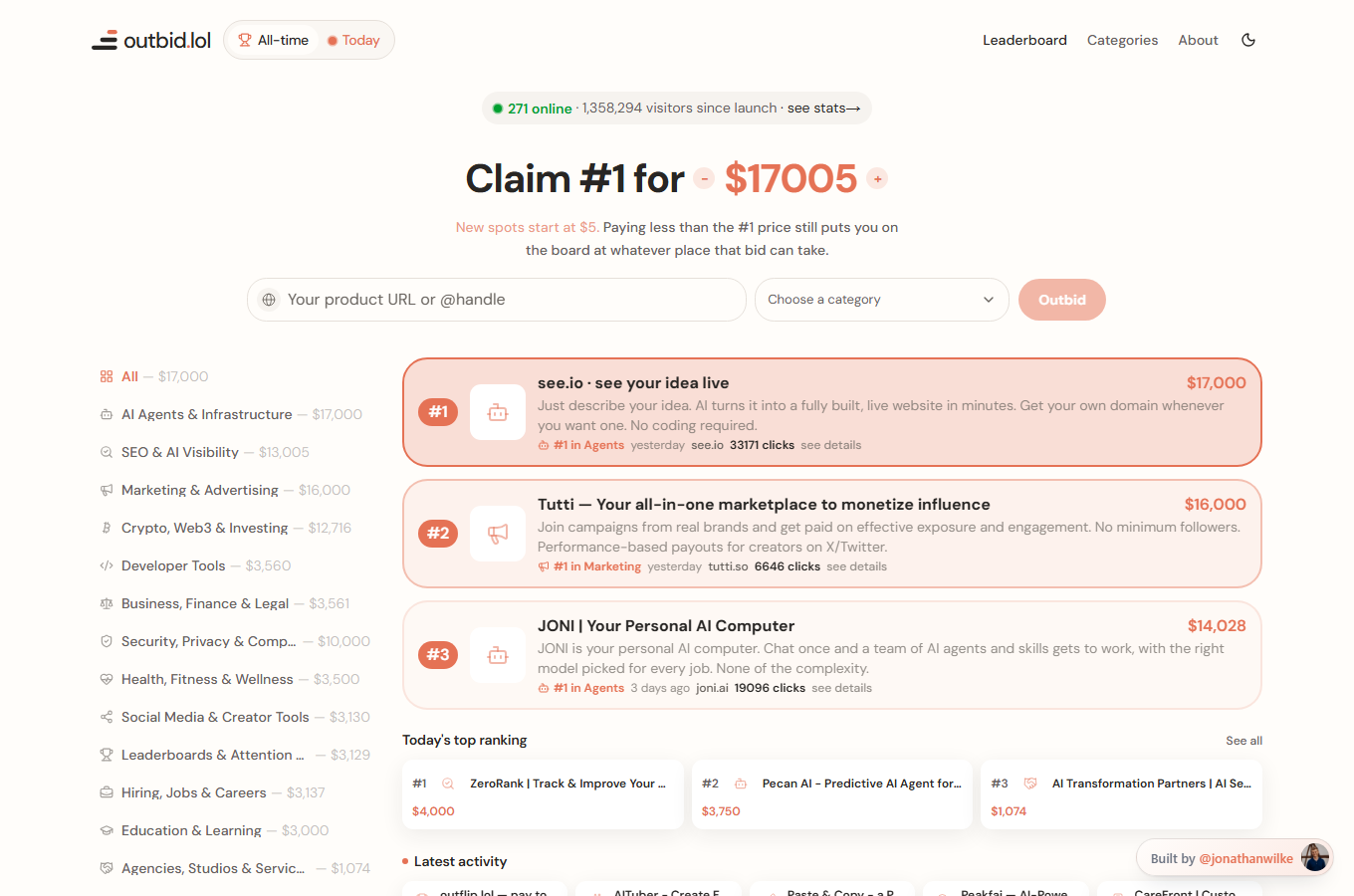
There is a detail that separates people who understand the economics from people who do not: outbid.lol runs two leaderboards side by side. The all-time board ranks by lifetime spend, which is why see.io's $17,000 holds the crown. The Today board ranks by what you spent in the last 24 hours only, and its top spot currently costs $4,005, less than a quarter of the all-time price.
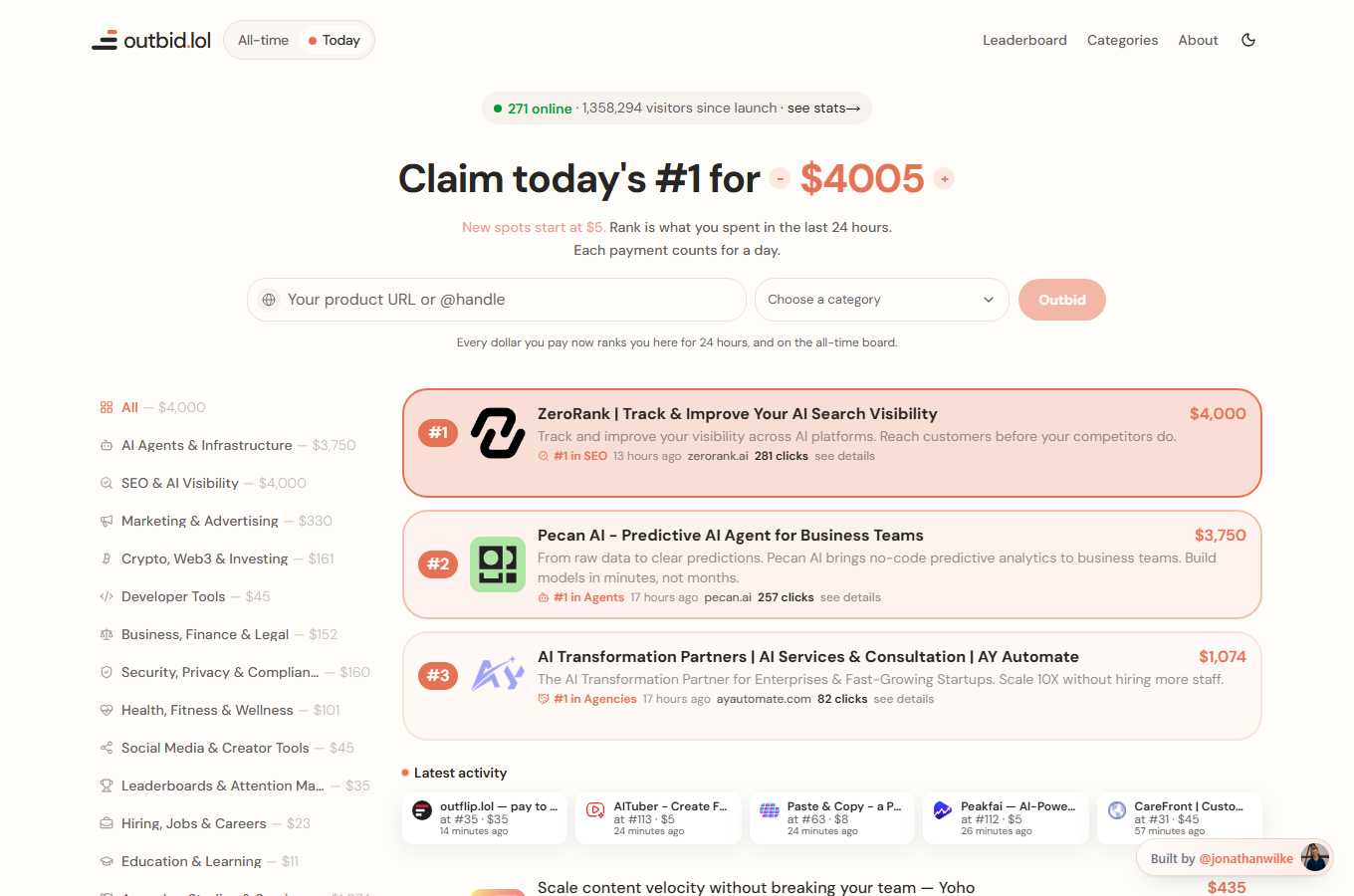
This creates two different games at once. The all-time board is a status monument: expensive, sticky, and humiliating to lose. The Today board is a rental: cheaper, volatile, and won by whoever wants the spotlight this specific day. Savvy bidders treat them as separate line items with separate budgets.
The category price ladder
Categories are where the pricing gets interesting, because demand is wildly uneven. Here is the cost of the number-one spot in selected categories from our August 26 snapshot:
| Category | Price of #1 (Aug 26) | Read |
|---|---|---|
| AI Agents & Infrastructure | $17,000 | Hottest money on the board |
| Marketing & Advertising | $16,000 | Growth tools fighting growth tools |
| SEO & AI Visibility | $13,005 | The meta cluster, see below |
| Crypto, Web3 & Investing | $12,716 | Speculators love speculating publicly |
| Security, Privacy & Compliance | $10,000 | Comp AI's enterprise play |
| Developer Tools | $3,560 | Crowded field, modest wallets |
| Business, Finance & Legal | $3,561 | B2B services at mid prices |
| Design & Creative | $1,027 | Cheap crowns available |
| Writing & Content | $660 | Underpriced relative to traffic |
| Directories, Launch & Discovery | $501 | Meta, naturally cheap |
| Ecommerce & Retail | $435 | Almost free relative to reach |
| People & Profiles | $300 | Personal brands, pocket change |
| Real Estate & Property | $117 | Nobody told real estate |
| Media & News | $45 | Cheapest crown on the board |
A #1 badge in Media & News costs $45 while overall #1 costs $17,000, a 377x spread on the same page with the same visitor stream. Niche-category crowns are the best risk-adjusted buy left on this board, especially paired with a good post about winning one.
Week One, Day by Day: The Timeline
The pace of this story is the story. Here is the verified sequence, with sources, from launch night through our snapshot:
| Date (2026) | What happened | Source |
|---|---|---|
| Aug 19, 11:08 PM CEST | Site goes live, built in roughly three hours | About page, founder posts |
| Aug 20 | $21,499 in bids in the first 24 hours, self-reported; analytics start straining | Founder on X |
| Aug 21 | JONI holds #1 above $14K; Comp AI publishes its demo-to-close sales math; first clone boards appear | X threads, SaaSCity timeline |
| Aug 22 | Founder newsletters declare auctions the launch tactic of the month; clone count accelerates | newsletter.founder.best |
| Aug 23 | Press release confirms $120K and 1M+ visitors in 48 hours via Markets Insider; Superframeworks logs ~$178K at hour 77; Best X Builds catalogs 85 clone boards | Markets Insider, Superframeworks |
| Aug 24 | Tibo posts Outrank's $12K results with full trial math; MakerThrive posts its $42-to-$29K story | X threads with screenshots |
| Aug 25 | A Reddit directory tracking live and dead clones reports 170+ boards scraped | r/webdev Showoff Saturday |
| Aug 26 (our snapshot) | $220,842 total revenue, 1,358,294 visitors, 1,570 listings, top bid $17,000 | Live counters on outbid.lol |
Two observations from that curve. First, revenue growth was steepest in the first 48 hours and visibly cooled after, which matches how novelty-driven traffic behaves everywhere. Second, the buyer mix shifted over the week: early bids were curiosity and memes, later bids were calculated marketing spends by teams with dashboards open. Boards like this attract speculators first and operators second.
Anatomy of the Board: Who Is Paying, and Why Them
Scroll past the top three and the mid-board tells you who this channel actually works for. Ranks four through ten during our snapshot were Outrank (SEO automation, $13,005), Orynth (community-invested product discovery, $12,716), CrowdReply (AI search citation outreach, $12,711), Comp AI (compliance automation, $10,000), ZeroRank (AI visibility tracking, $4,000), Pecan AI (predictive analytics, $3,750), and FloPay (payment orchestration, $3,561).
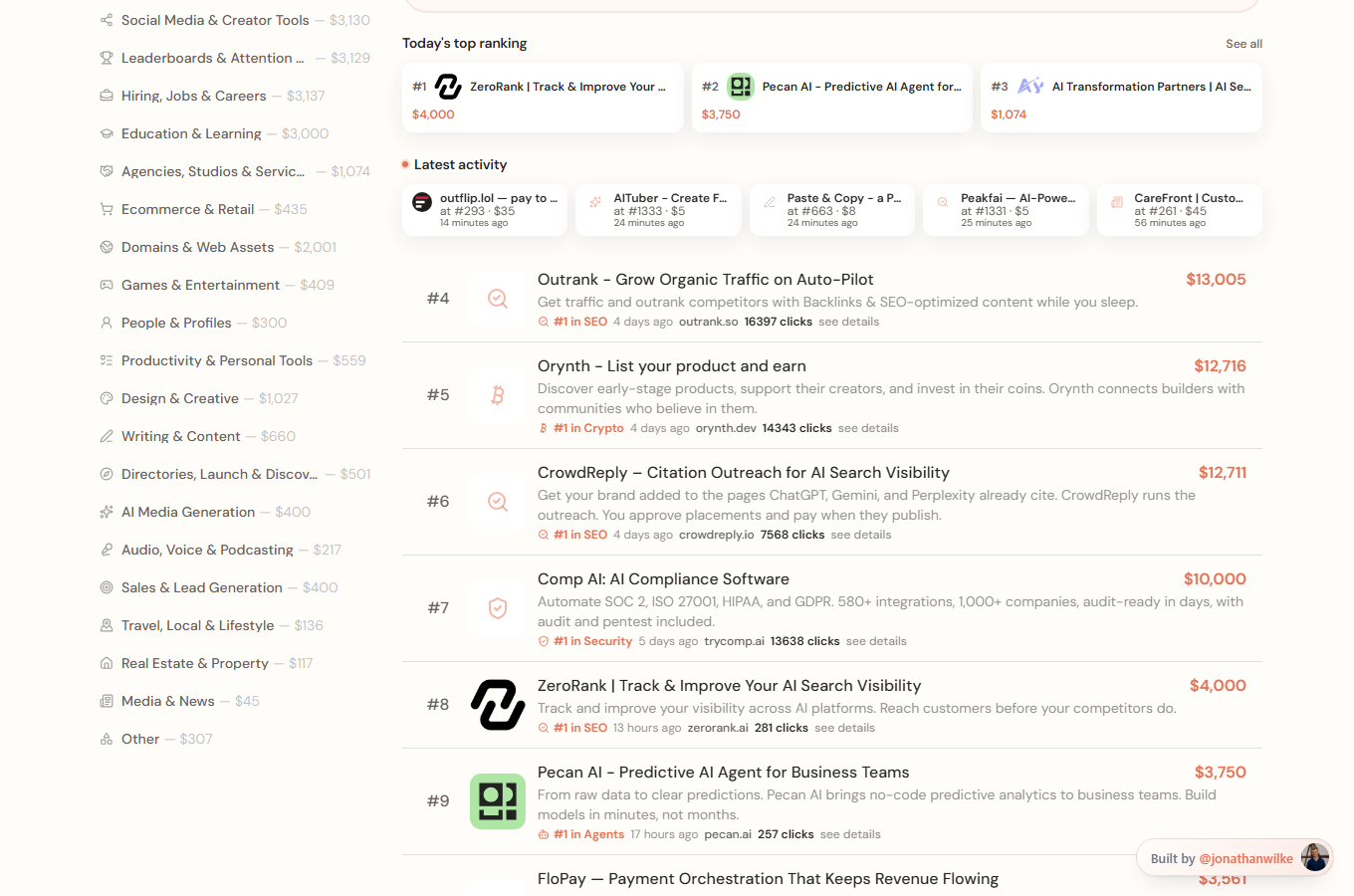
Look at that list again and count the categories. An SEO automation tool, a citation outreach service, an AI visibility tracker, a compliance platform selling to startups, a predictive analytics vendor, and a payments SDK. These are all products with annual contract values in the thousands, sold to exactly the audience scrolling this board. The click counts reward them accordingly: Outrank sat at 16,397 clicks, Comp AI at 13,638, JONI at 19,096.
Meanwhile the bottom of the board is a long tail of local businesses, side projects, and experiments sitting at $5 to $45, collecting occasional clicks from deep scrollers. With 1,570 listings and counting, deep-board placement is close to worthless. Value concentrates hard at the top and in category crowns. This is a power-law attention market, not a level playing field, and budgeting accordingly is the difference between a lesson and a loss.
Why It Exploded: Five Forces Working Together
Force 1: The barrier was a coffee, not a campaign
A Product Hunt launch demands assets, timing strategy, hunter relationships, and community goodwill banked over months. An outbid.lol entry demands five dollars and ninety seconds. Launch fatigue is real in founder circles, and zero-friction participation is the same recipe that made Wordle and sticker charts spread: instant to join, instantly comparable.
Force 2: Every outbid manufactured fresh drama
Static directories go quiet after launch week. This board generates a new event every time someone pays, because displacement is public and instantaneous. When see.io took the crown, that moment was screenshotted, quoted, and argued about across X within the hour. The leaderboard produces content without anyone shipping a feature.
Force 3: Spending money became the advertisement
Founders posted their bids as flexes, experiments, or cautionary tales, and every thread pulled new eyeballs back to the board. The buyers funded the distribution themselves. Customer acquisition cost for the platform stayed near zero while buyers did the marketing, which is either genius or shameless depending on which side of the payment form you stood.
Force 4: The audience and the advertisers were the same people
Nearly everyone bidding is also someone who scrolls founder Twitter hoping to be seen by founders. The product being sold, attention from the startup crowd, is precisely what every bidder wants to purchase for themselves. Closed loop, self-sustaining, at least for a news cycle or three.
Force 5: The dot-lol framing lowered defenses
The TLD signals internet experiment rather than enterprise vendor, which did two jobs simultaneously. It lowered expectations (nobody audits a .lol for SOC 2 posture) and raised curiosity (what is this thing). Compare the reception a identical product on .io would have received: scrutiny instead of amusement. Amusement travels further.
The Receipts: What Buyers Actually Got
Opinions about outbid.lol are cheap and everywhere. Public outcome data is scarcer, but four teams posted detailed numbers with screenshots. All are self-reported, all verifiable, and together they form the honest answer to whether this channel works.
CrowdReply: the $12,700 blitz that worked
CrowdReply bought the number-one spot for $12,700 and posted the aftermath 48 hours later: 6,550+ clicks, 1,800 signups, more than 50 demo calls booked, a claimed $50K per month pipeline, and 500+ new followers. Their raw arithmetic works out to roughly $7 per signup, and their sales team then only needs to close a handful of deals at citation-outreach price points to clear the bid entirely. Their own verdict: absolutely worth it.
Outrank: the $12,000 experiment with pre-committed math
Tibo, co-founder of Outrank.so, framed his bid publicly as a bet with explicit break-even conditions before he paid. Over the following weekend the site logged 44, 38, and 31 trials per day against a normal baseline of about 20. That is 53 incremental trials. At Outrank's historical 50 percent trial-to-paid rate and roughly $2,000 customer LTV, he needed just 11 percent of those extra trials to stick to break even.
Most people told me it was just bragging with money. I have room to be wrong by a lot and still win this.Tibo (@tibo_maker), posting his Outrank bid results on X, August 24
MakerThrive: the $42 lottery ticket
The cheapest and most-cited lesson on the board. A $42 bid briefly held number one during a quiet window, pushing 64,000 visitors to a pixel-site project that reported $29K in revenue in a single day. A 690x return on the bid itself. This is the outcome everybody remembers, and it is also the least repeatable: it required a gap in the board's armor that closed permanently once prices climbed three hundred times above the floor.
Comp AI: the enterprise unit-economics play
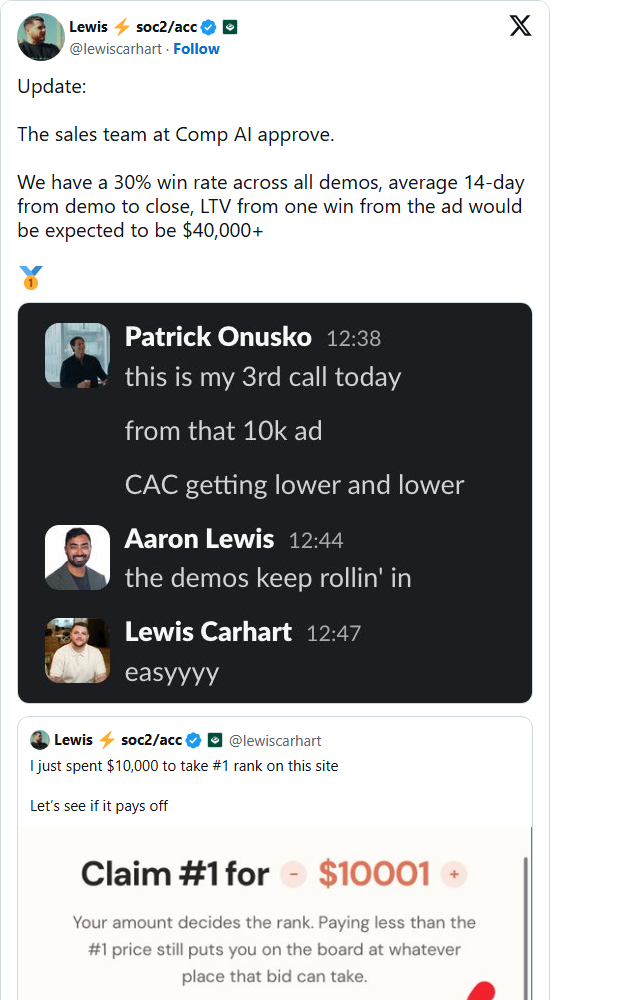
Comp AI sat seventh with a $10,000 total and shared their reasoning openly: a 30 percent win rate across demos, an average 14 days from demo to close, and an expected lifetime value north of $40,000 per closed deal. For a company with those numbers, a handful of extra demos covers the entire board. Their sales team approved the spend retroactively, which tells you how the internal conversation went.
The pattern underneath the four stories
Every winner sells something expensive to founders: compliance automation, SEO tooling, citation outreach, growth services. Curiosity traffic converts when your product costs thousands per year and your buyer is already in a buying mood. Nobody has posted a comparable success story for a low-priced consumer app, and absence of evidence after a week this loud is itself evidence.
Winners post screenshots; losers stay quiet. For every CrowdReply thread there are uncounted mid-board bidders with flat analytics and nothing to show. Treat published ROI stories as the ceiling of the distribution, not the average.
The Meta-Game: SEO Tools Buying Visibility on a Giant Billboard
Here is the irony we enjoyed most. Scan the top ten and you find Outrank, CrowdReply, ZeroRank, and fatjoe, all companies whose core promise is getting you seen on the internet. They bought visibility on somebody else's board the way their customers buy visibility from them. The SEO industry spent a week paying for placement on a domain with zero authority, which tells you everything about how the smartest operators classify this channel: pure demand capture and brand theater, not search equity.
It is also a live demonstration of where their own industry is heading. Several of those products sell AI search visibility, the practice of appearing in ChatGPT and Perplexity answers. Being cited by an AI and being ranked on a viral leaderboard are the same underlying game, attention aggregation, played on different boards. The tooling just changed shape.
Reading the Click Counts: What 33,171 Clicks Is Actually Worth
The public click counters are the most underrated dataset on the site, because they let anyone audit performance without trusting anybody's screenshots. During our snapshot the numbers looked like this: see.io at rank one with 33,171 clicks on a $17,000 total, JONI with 19,096 clicks at $14,028, Outrank with 16,397 at $13,005, Comp AI with 13,638 at $10,000, and Tutti, remarkably, with only 6,646 clicks despite holding the number-two spot at $16,000.
That Tutti number deserves a pause. Same board tier, higher spend than Outrank, but 60 percent fewer clicks. Position alone does not explain it. The likely culprits are listing presentation, description clarity, and how interesting the linked product looks at a glance, which means your listing copy is doing conversion work before any click happens. A boring description on a $16,000 listing is a tax paid on every single view.
| Listing | Total bid | Clicks | Cost per click |
|---|---|---|---|
| see.io | $17,000 | 33,171 | $0.51 |
| JONI | $14,028 | 19,096 | $0.73 |
| Outrank | $13,005 | 16,397 | $0.79 |
| Comp AI | $10,000 | 13,638 | $0.73 |
| CrowdReply | $12,711 | 7,568 | $1.68 |
| Tutti | $16,000 | 6,646 | $2.41 |
Expressed as cost per click, the board suddenly becomes comparable to ordinary advertising. Fifty-one cents to $2.41 per click sits squarely in paid-social range and below many B2B search keywords, which is a completely different framing than the headlines suggest. The catch is real, though: these clicks arrived during the highest-traffic week the site will likely ever have, they do not recur, and there is no retargeting pixel catching visitors who bounce. As a one-time media buy during a viral moment, the top listings were actually cheap. As a recurring channel, the same spend next month buys far less attention.
The click counters are public. Before bidding on any rank, look up what similar ranks actually delivered this week, not at peak. The board's own data is the best forecasting tool available, and most bidders apparently never opened it.
Should You Bid? The Five-Step Math to Run First
If you are considering a bid, run this sequence before touching the payment page. It takes fifteen minutes and it is the entire difference between the buyers who posted wins and the quiet ones who did not.
- Estimate clicks for the rank you can afford. Mid-board ranks pulled roughly 50 to 1,000 clicks per week during peak frenzy; top-five positions cleared 6,000+. Traffic has cooled since launch week, so use the conservative end.
- Apply your real visitor-to-signup rate. Leaderboard visitors are curious, not searching. Assume 1 to 3 percent unless you have funnel data proving otherwise.
- Compute cost per signup. Bid divided by estimated signups. Then compare that number against your other channels, never against zero.
- Price the story, not just the clicks. A mid-size bid that trends on X earns newsletter mentions and hands you a screenshot is doing three jobs at once. Most winners say the social halo outweighed the traffic.
- Set a stop-loss before you start and honor it. Auction psychology is engineered against you here. Decide your maximum cold, and never chase the crown on adrenaline.
Three worked examples
| Scenario | Bid | Est. clicks | Signup rate | Signups | Cost per signup |
|---|---|---|---|---|---|
| Small test, mid-board | $200 | ~400 | 2% | 8 | $25.00 |
| Niche category crown | $1,300 | ~1,200 | 2.5% | 30 | $43.33 |
| Top spot (CrowdReply actual) | $12,700 | 6,550+ | 27% | 1,800 | ~$7.06 |
Read that middle row carefully, because it is the realistic best case for most readers. Thirty signups for $1,300 is defensible only if your product carries a high annual contract value. If you sell at nine dollars a month, even the optimistic column fails the math, and no amount of optimism fixes unit economics.
Every dollar bid is spent, permanently, win or lose. Budget accordingly: if losing the full amount would hurt, the bid is too big.
Timing, Timezones, and the Rhythm of the Board
Attention on the board has a daily shape, and the activity feed makes it visible. New bids cluster when founder Twitter is awake: European morning, US midday, and a second smaller pulse in the US evening. The quietest stretch runs roughly 2 AM to 6 AM Central European Time, which is exactly when the cheap opportunistic bids land, like MakerThrive's $42 crown grabbed during a lull.
The Today board sharpens this rhythm into strategy. Because it only counts trailing 24-hour spend, a bid placed at the start of the US business day buys the entire high-traffic window, while the same bid at midnight European time gets diluted across dead hours. If you ever run a Today-board play, align the payment timestamp with when your audience is actually scrolling.
Weekly rhythm matters too. Launch-week traffic was a spike, but the residual baseline still pulses on weekdays over weekends, and every X thread from a bidder creates a mini-surge that decays within hours. The practical playbook: bid when a story is about to break (your own post, a podcast appearance, a newsletter mention), so paid placement and earned attention land in the same window instead of wasting each other.
The Rails: Polar, the Live Counter, and the Self-Funding Loop
It is worth naming the infrastructure choices that made the growth loop spin, because they are copyable. Payments run through Polar, a merchant-of-record platform popular with indie developers, which meant Wilke never touched invoicing, tax compliance, or dispute handling. One API key and the money flow existed. Total payments plumbing time: trivial.
Then there is the counter. Putting total revenue on the public homepage is a small decision with enormous consequences. Every bid raises a number that thousands of watching people can see, which means each payment is simultaneously inventory purchase, social proof, and free advertising of the site's own success. The counter did the selling. By the time journalists arrived, the headline ($120K in 48 hours) was already written by the homepage itself.
Compare that to the standard directory model, which hides revenue, gates listings behind review queues, and grows at the speed of SEO. outbid.lol grew at the speed of a visible number ticking upward. If you build anything with a marketplace dynamic, ask what your equivalent of the public counter is. If the answer is nothing, you are leaving your fastest growth loop uninstalled.
After the Click: What Separated Winners' Landing Pages
A click from the board is the most expensive curiosity you will ever buy, and the four public winners treated it accordingly. Look at what their landing pages had in common and the checklist writes itself. CrowdReply sent board traffic to a page with one claim above the fold, demo booking two scrolls deep, and a founder video explaining the exact problem the board audience already felt. Comp AI routed clicks into a demo-request flow with compliance badges visible instantly, matching the trust needs of their buyer.
Outrank did something clever: the landing page acknowledged the stunt. Visitors who clicked the listing arrived to find the bid itself part of the pitch, which turned a curiosity click into a story continuation. Tibo's follow-up thread then closed the loop publicly with trial math, so the audience got a narrative arc instead of an ad. That is three touches (board, page, thread) from one spend.
- Match the page to the mood: board traffic is curious and skeptical, so lead with proof, not features
- Make the next step obvious in one screen: demo, trial, or signup, never a menu of six options
- Capture something even from non-converters: a newsletter box beats a lost bounce at $1.68 per click
- Close the loop publicly afterward: the follow-up thread is where the bid compounds into credibility
The losers' pattern was just as consistent: generic homepages with no message match, no acknowledgment of where the visitor came from, and no retargeting. Paying board prices to deliver an untailored page is like renting a billboard and painting it after the traffic drives past. The bid buys the visit; the page decides what it costs you.
How to Actually Win on outbid.lol (a Playbook)
Everything so far tells you the odds. Here is the playbook the successful teams ran, distilled into steps you can actually follow rather than vibes.
- Prove your product to founders first. Every winner sells something a startup founder emotionally recognizes as urgent: compliance, SEO, growth, or data. If you cannot make that case in one line, stop before you start.
- Buy a category crown, not a top-three slot. The same visitor stream is 300x cheaper in an unclaimed niche. Owning a niche, then sharing that win, beats bleeding out for seventh overall.
- Align the bid with a story break. Bid when a launch post, podcast, or newsletter is about to drop, so the purchased placement and the earned attention land together.
- Tailor the landing page in advance. One claim above the fold, one obvious next step, proof not features. Add a retargeting pixel before the bid goes live.
- Write the follow-up thread before, not after. The bid compounds only when you post the outcome with numbers. Draft the receipts template while you still remember what you expected.
- Set the stop-loss and walk away at it. The board never feels expensive during a bidding rush. Your cold maximum is the only number that protects you.
As of the Aug 26 snapshot, Media & News #1 cost $45 while overall #1 cost $17,000. Niche-category crowns on the same page are the cheapest way to buy the board's audience, and most bidders are still fighting over the expensive top rows.
outbid.lol vs LastSpot.lol vs the Decay Model
The most common question founders ask is how outbid.lol's permanent auction compares to the decay-based clones, and it is a real strategic fork. outbid.lol has no decay and no cap: your listing holds until someone outbids you. LastSpot.lol caps the board at 100 spots and applies a 5% daily bid decay, so every rank silently erodes and demands continuous re-investment. billbored.lol removes auctions entirely with 100 fixed slots at a flat $10.
Those are two different products pretending to be one niche. outbid.lol rewards one big, visible spend that compounds through story value. Decay boards favor relentless small re-investment over time, which means recurring revenue for the host and a treadmill for you. For a one-time launch push, outbid.lol's permanence fits. For an always-on presence some agencies are starting to run, the decay model keeps your name front and center at a steadier cost. Most operators we tracked ended up staging their budget across one big outbid purchase and a low-stakes decay board seat, using each where its mechanic is honest.
If comparing pay-to-rank boards is your interest, the meta-directories like biddirectory.lol now track live bids across a hundred plus competitors, which is both a resource for research and, ironically, proof that the niche already became its own ecosystem.
outbid.lol vs Product Hunt vs Directories vs the Clones
Where does a bid fit against the other ways founders buy launches? We compared the mechanics honestly:
| Channel | Cost model | What you get | Lasts | Best for |
|---|---|---|---|---|
| outbid.lol (all-time) | $5 floor, auctions to $17K+ | Curiosity traffic burst, social proof moment, zero SEO value | Until outbid | Funded teams selling high-ticket to founders |
| outbid.lol (Today board) | ~$4K for #1 right now | 24-hour spotlight at a quarter of all-time price | 24 hours | Time-boxed promos and launch-day spikes |
| Product Hunt | Free, brutal time cost | One big day, lasting profile, badge credibility | Badge forever, spike fades | Products with community backing |
| Established directories | Free tiers to $$$ | Permanent listing, sometimes follow links, slow drip | Years | Long-tail discovery and authority |
| LastSpot.lol | Flat fee, 100 slots, 5% daily decay | Recency-driven visibility forcing re-investment | Decays daily | Short aggressive promos |
| billbored.lol | Fixed $10, 100 slots | Cheap seat with recency push when new claims land | Until pushed | Testing the format cheaply |
| payluck.lol | $9.95 list, random coupon locks price | Scarcity seat, no bidding war possible | While board lasts | Budget-bound indie hackers |
| Paid newsletters | Flat sponsor rate | Intent-heavy audience, measurable clicks | One send | Direct response offers |
Notice what each row actually sells. Established directories sell permanence. Newsletters sell intent. Product Hunt sells community endorsement. outbid.lol sells urgency and spectacle. None of these substitute for another, and the teams getting the most from the format treated a bid as one line in a launch stack rather than the whole strategy.
The Clone Wave: A Field Guide
Within days of launch the copies arrived, and they are instructive because each one isolates and mutates a single variable of the original formula. A community scraper catalogued more than 170 live and dead boards within the first week. The survivors worth knowing:
| Board | Mutation | Why it exists |
|---|---|---|
| payluck.lol | Random coupon locks your final price forever, boards of 50 seats | Removes the wallet war, sells scarcity instead |
| billbored.lol | 100 fixed slots at flat $10, new claims push old ones down | Recency beats budget, democratized |
| LastSpot.lol | 100 spots with 5% daily bid decay | Forces continuous re-investment, recurring revenue for the house |
| bidboard.lol | Free listing, pay only to move up | The SEO-safer twist: link without payment |
| biddirectory.lol | A directory that ranks bidding directories | Full meta recursion, by Damon Chen |
| growu.lol and dozens more | Straight clones of the original | Pure trend-surfing, most already dead |
Strip the memes away and the underlying idea predates the internet by millennia: public auctions for visible status. What changed in August 2026 is that building the auction now takes an evening, distributing it takes one good X thread, and payments take an API key. Expect pay-to-rank mechanics to keep mutating: time-decay models, capped boards, luck pricing, vertical niches. The specific sites will fade. The mechanic has entered the playbook.
Thinking of Building Your Own? The Honest Playbook
Plenty of readers will look at $220K in a week and reach for a clone. Before you do, understand what actually repeated across the survivors and what killed the also-rans, because the graveyard is much larger than the leaderboard.
- Ship the loop, not the list. The winners all expose live numbers (revenue, bids, activity feeds). Static boards died in days because there was nothing to check back for.
- Pick one variable and mutate it hard. payluck removed the wallet war, billbored removed auctions, LastSpot added decay. Straight clones with no twist got neither press nor bids.
- Niche down or die. The generic attention market is taken. A pay-to-rank board for a single vertical (indie games, newsletters, open-source repos, local businesses) has pricing power the generalists already lost.
- Solve the merchant problem first. Polar or a similar merchant-of-record means you never touch tax compliance. This is a solved problem; do not rebuild it.
- Have a day-two plan. outbid.lol's retention story is weak by design. If you want a business rather than a moment, plan the email capture, the follow-up product, or the marketplace that survives after the spike.
And the honest caveat: the window for generic clones has closed. A hundred boards launched within a week and most are already ghost towns. The format is proven; the differentiation is the product now. If your only plan is the same auction with a different domain, the market has spoken about that already.
The Criticisms, Taken Seriously
- Near-zero friction participation produced real, documented wins for high-LTV sellers
- Transparent totals and public click counts make outcomes checkable, unlike most ad channels
- Category crowns and the Today board offer genuinely cheap experiments
- The social halo (threads, newsletter mentions, followers) often beat the direct traffic
- Attention is rented: stop paying or get outbid and visibility vanishes, nothing compounds
- Domain authority is near zero, so there is no meaningful SEO or backlink transfer
- Survivorship bias distorts perceived success rates badly
- The house wins regardless of bidder outcomes, and there are no refunds
- Traffic already cooled from launch-week highs; the window may be closing
The strongest critique is structural: this is a market where the seller cannot lose and the buyer usually does not know their odds. Auction formats monetize competitive emotion, and competitive emotion is a terrible CFO. The teams that did well arrived with spreadsheets and stop-losses. The teams that did poorly arrived with adrenaline.
The second critique concerns what the board does to trust in launch media generally. When placement is explicitly purchasable and displayed next to click counts, the implicit signal of curated directories (somebody vouched for this) is gone. That is honest, in its way. But it trains both founders and audiences to assume every ranking is for sale, which has spillover costs for channels that still trade on curation.
The questions nobody asked: fraud, moderation, and trust
A week of breathless coverage mostly skipped the operational risks, so let us name them. Click counts are self-reported by the platform with no third-party verification, and a listing owner has no way to audit what portion of clicks were human. Payment disputes route through the merchant of record like any card transaction, but a board this simple has no meaningful fraud screening on who lists what. Trademark squatting on the board is possible: nothing stops a competitor from listing your brand name at $5 and letting the screenshot do damage.
None of this diminishes the achievement, and to be fair, a three-hour side project should not be judged against enterprise vendor-risk standards. But if pay-to-rank mechanics get adopted by serious platforms, these are exactly the gaps that will need solving: verified click analytics, listing ownership claims, and some moderation surface for abuse. Watch that space, because whoever solves trust for attention markets has a real product.
Is it a backlink play?
No, and believing otherwise is the most common analytical error we saw during the frenzy. The domain is brand new with negligible authority, reports differ on link attributes across snapshots, and treating the board as an SEO buy misreads the product completely. This is a traffic-and-story purchase. If you want links, our guides on building durable authority cover channels that compound instead.
So, Is It a Bubble?
Our read: the specific board is a wave, the mechanic is a fixture. Visitor velocity clearly cooled after the first 72 hours, clone fragmentation sliced the novelty thin, and attention markets like this historically have one large crest followed by a long shallow tail. We would be surprised if outbid.lol sustains launch-week revenue levels through the autumn.
But the underlying invention deserves credit: Wilke proved that a transparent, self-funding attention market can be stood up in an evening and generate six figures immediately. Every launch platform founder studied that demonstration. Expect elements to be absorbed: decay mechanics in premium placements, public spend counters on directories, category auctions in established communities. The wave breaks, the shoreline moves.
Verdicts by Situation
- Funded B2B teams selling $10K+/year tools to startup audiences: a calculated top-ten or category-crown bid is defensible as traffic plus PR, CrowdReply-style
- Small-budget founders with something genuinely interesting: a $50 to $500 category play plus a strong X thread about it is a cheap, bounded experiment
- Agencies and marketers studying attention markets: the board is a live masterclass in friction, FOMO, and public commitment
- Personal brands wanting a story: the People & Profiles crown costs less than dinner
- Pre-revenue founders: your five dollars have better uses almost anywhere
- Low-price consumer apps: the math fails at every bid level we modeled
- Anyone needing compounding results: nothing here survives the month
- Teams without a stop-loss discipline: the format is engineered to make you overspend
Overall as a channel we land at 3.5 out of 5, trending down as attention normalizes. Spectacular at creating a moment. Weak at creating an asset. Buy moments knowingly, and only when the spreadsheet says the moment is worth more than the money.
Four Lessons Founders Can Steal Without Bidding
- Ship the counter, not just the product. A public number climbing in real time (revenue, visitors, streaks) is the cheapest growth loop ever demonstrated. Wilke's revenue ticker was the campaign.
- Friction is a launch decision. Three hours of build and ninety seconds of participation beat polished onboarding when the goal is spread, not retention.
- Let buyers market to each other. Every bid announcement was free distribution funded by the customer. Design surfaces that make your users' success inherently postable.
- Publish receipts. CrowdReply, Outrank, and Comp AI converted spend into second-order credibility by sharing numbers openly. Transparency compounded their bids beyond the clicks.
The deepest takeaway is about distribution speed. The moat of every directory that took years to build mattered less for one week than a leaderboard built in one evening with a payment form. Distribution advantages are temporary now, and the half-life keeps shrinking. Plan launches for bursts, and build assets for everything else.