 Build my stack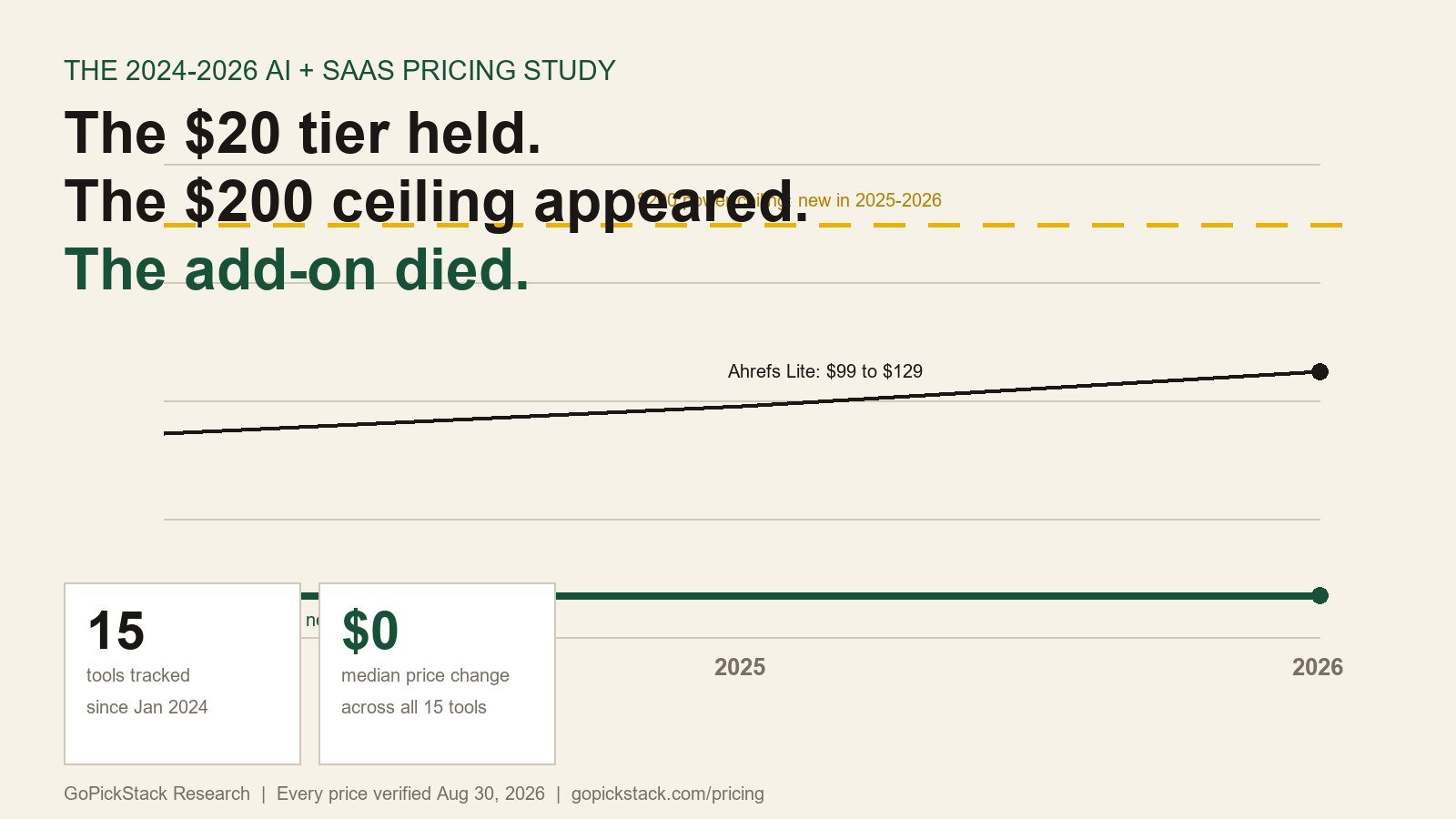
- The median entry-price change across 15 tracked AI and SaaS tools from January 2024 to August 2026 is zero: 10 of 15 prices are unchanged, verified on official pricing pages August 30, 2026.
- The $20 Pro tier is the industry anchor and never moved: ChatGPT Plus, Claude Pro, Cursor Pro, and Devin Pro all still cost $20 a month, and Claude's annual plan cuts the effective price to $17.
- A new $100-$200 power ceiling appeared above it: ChatGPT Pro ($100/$200), Claude Max ($100/$200), Copilot Max ($100), and Devin Max ($200) monetize heavy users instead of raising the base price.
- The standalone AI add-on died: Notion retired its $10/user add-on (AI now bundled in Business at $20), Slack bundled AI into Pro and Business+, and ClickUp and Figma moved to credits systems.
- The verified list-price increases: Figma Professional $12 to $16 (+33 percent, the largest), Ahrefs Lite $99 to $129, and Semrush Pro $129.95 to $139.95, plus silent restructures at Linear ($8 Team became $10 Basic/$16 Business) and Devin (Windsurf $15 became $20).
- Usage credits replaced flat limits across 7 of 15 tools (GitHub, Figma, ClickUp, Claude, Cursor, Devin, Zapier), reintroducing unpredictable metering: a realistic power-user bill now runs $400-$520 versus 2024's fixed $60 ceiling.
- Team math flipped in buyers' favor when bought deliberately: a 5-person stack that cost $271 in 2024 costs $239 with smart 2026 bundles, but $371 if you keep 2024 buying habits.
We tracked the prices of 15 widely used AI and SaaS tools from January 2024 to August 30, 2026, re-verifying every number on official pricing pages. Three things actually happened. First, the standard $20 Pro tier never moved: ChatGPT Plus, Claude Pro, Cursor Pro, and Devin Pro all still cost $20 a month. Second, every vendor built a new ceiling above it: $100 to $200 power tiers (ChatGPT Pro, Claude Max, Copilot Max, Devin Max) now monetize heavy users instead of raising the base price. Third, the standalone AI add-on died: Notion killed its $10 AI add-on, Slack bundled AI into Pro and Business+, and Figma and ClickUp moved to credits systems. Ten of 15 entry prices are unchanged since 2024. The five that moved: Ahrefs Lite ($99 to $129), Semrush Pro ($129.95 to $139.95), Figma Professional ($12 to $16, the largest increase we verified), plus restructures at Linear and Devin. Your bill still went up, and this study shows exactly where the money went.
Every week someone publishes a hot take claiming AI tools are getting more expensive, or cheaper, or free, or dead. Most of those takes are built on one price a writer noticed on one afternoon. We wanted to know what actually happened over time, so we did something simple and repetitive: we recorded prices, again and again, for two years.
This study covers 15 tools we track continuously at GoPickStack: ChatGPT, Claude, Cursor, GitHub Copilot, Devin (which absorbed Windsurf), Slack, Notion, Linear, ClickUp, Zapier, Ahrefs, Semrush, Figma, Canva, and GitHub the platform (Team plan). Our tracker logs the entry paid price for each tool, the price most small teams actually buy first. Today, August 30, 2026, we re-verified 14 of the 15 on their official pricing pages in a single sitting (Canva blocks automated reads; its last full verification is July 19, 2026, noted below). Every other number in this study is same-day current.
The result surprised us. The story of AI and SaaS pricing from 2024 to 2026 is not a story about price increases. It is a story about price stability at the bottom, aggressive new ceilings at the top, and a quiet migration of value into metered credits and usage limits. Your sticker price mostly held. Your bill did not.
Two years of tracked prices show a flat $20 floor, a brand new $100-$200 ceiling for power users, the death of the simple per-seat AI add-on, and one quiet 33 percent increase at Figma nobody talks about. If you buy AI tools like it is still 2024, you are either overpaying for seats you do not use or hitting limits you did not know existed.
Founders, finance leads, and heavy AI users who want to know exactly where subscription prices moved and where the real costs now hide (credits, seats, and power tiers).
People looking for coupon roundups or promotional pricing. This is a price-change study built on list prices verified August 30, 2026.
How We Tracked These Prices (Our Method, in Plain English)
GoPickStack maintains a public pricing history tracker for the tools we review. Every tool in this study has dated price points recorded from January 2024 onward, and the full history is visible on our pricing tracker pages. For this study we pulled every entry, re-verified the tools on their official pricing pages on August 30, 2026, and compared the January 2024 entry price against today's entry price.
- What we track: the entry paid plan for individuals (or the entry team plan where that is the primary product, like Slack and GitHub). This is the price a small team actually pays first.
- What we exclude: promotional prices, regional pricing, lifetime deals, and app-store pricing. List prices only, USD, monthly billing unless stated.
- Verification: every price in this study was re-checked on the vendor's official pricing page today, August 30, 2026, except Canva (blocked to automated reads; last verified July 19, 2026 in our tracker, unchanged at that date). Nothing is from memory, archive sites, or third-party blogs.
- Honesty note: when a vendor changes what a plan includes instead of the price (limits, credits, features), we count that as a real change and call it out, because it changes what you get for the same dollar.
Every figure here is either (a) verified on an official pricing page today, or (b) a dated data point in our public pricing tracker with the verification date attached. If you are a journalist or blogger writing about AI pricing, link the study and the tracker, not a screenshot. We keep both updated on a 15-day verification cycle.
The Master Table: 15 Tools, Then vs Now
Here is the whole study in one table. Entry paid price in January 2024, entry paid price on August 30, 2026, and what actually changed in between. Read the last column carefully: it is where the real story lives.
| Tool | Jan 2024 | Aug 30, 2026 | What actually changed |
|---|---|---|---|
| ChatGPT Plus | $20 | $20 | Added Pro $100 and $200 tiers; Go tier added; base unmoved |
| Claude Pro | $20 | $20 | Added Max $100/$200; annual option equals $17/mo; base unmoved |
| Cursor Pro | $20 | $20 | Tiers became Pro/Pro+/Ultra; usage-based billing; Teams now $40/user |
| GitHub Copilot Pro | $10 | $10 | Added Free tier, credits system, Pro+ $39 and Max $100 tiers |
| Devin (Windsurf) | $15 | $20 | Windsurf merged into Cognition's Devin; one Free/$20/$200 ladder |
| Slack Pro | $7.25 | $8.75 | One 2024 increase to $8.75; AI now bundled, not a $10 add-on |
| Notion Plus | $8 | $10 | One 2024 increase to $10; separate $10 AI add-on replaced by trial + Business AI |
| Linear (entry paid) | $8 | $16 | Team plan $8 became Basic $10 and Business $16 (restructure) |
| ClickUp Unlimited | $7 | $7 | Base flat; new Brain AI $9 and Everything AI $28 tiers added on top |
| Zapier Pro | $29.99 | $29.99 | Monthly price unmoved; annual entry still $19.99; ladder now sells task tiers up to 2M |
| Ahrefs Lite | $99 | $129 | Raised to $129 (Dec 2024); added $29 Starter and free tier (2026) |
| Semrush Pro | $129.95 | $139.95 | One increase to $139.95 (Dec 2024); ladder rebranded around AI search |
| Figma Professional | $12 | $16 | Raised to $16 (verified today); seat types split; AI credits added |
| Canva Pro | $12.99 | $12.99 | Unmoved through last verification (July 19, 2026) |
| GitHub Team | $4 | $4 | Unmoved; value moved to Copilot tiers and credits |
Count the middle columns. Of 15 tools, 10 charge the same entry price today as in January 2024. Three raised it (Ahrefs, Semrush, Figma). Two restructured upward by splitting cheap plans into more expensive ones (Linear, Devin). The median list-price change across the set is zero.
Now count the last column. Nine of the 15 tools added something above or beside the entry tier: power tiers, AI tiers, or credit systems. That is where your money went.
Finding 1: The $20 Pro Tier Never Moved, and That Is the Strategy
If you had subscribed to ChatGPT Plus, Claude Pro, and Cursor Pro in January 2024, your combined bill was $60 a month. Check that same subscription today: still $60. Not one of the three raised its base price in two and a half years, through a chip shortage of reasoning models, an AI price war, and multiple rounds of supposedly industry-changing launches. Devin, the newest major entrant, priced its Pro plan at exactly $20 as well.
That flat line is not laziness. It is the single most studied number in consumer software. Twenty dollars is the price of a streaming family plan, a premium meal, two coffees a week. Every AI vendor ran the same psychology: get the entry price under the threshold where people stop evaluating and start subscribing, then never touch it, because a raise would trigger exactly the churn-and-headline cycle that kills subscription businesses.
The one asterisk: Claude introduced an annual plan that works out to about $17 a month ($200 a year, billed up front) versus $20 monthly. That is the only real entry-price improvement any major AI vendor made in the study window, and it rewards the exact behavior vendors want: commitment. OpenAI, in contrast, confirmed in its help docs that no annual billing exists for Go, Plus, or Pro, so $20 is the only door into ChatGPT Plus.
Finding 2: The New $100-$200 Power Ceiling
The flat floor hides a new ceiling. In January 2024, the most you could pay OpenAI for a personal ChatGPT subscription was $20 a month. Today the ladder runs Plus $20, Pro $100 (5x usage), Pro $200 (20x usage). Anthropic followed the same shape: Pro $20, Max 5x $100, Max 20x $200. GitHub Copilot built Free, Pro $10, Pro+ $39, Max $100. Devin launched Free, Pro $20, and a new Max tier at $200. Cursor's Pro plan split into Pro, Pro+ (3x limits), and Ultra (20x limits) with usage-based billing on top.
| Vendor | Free | Entry paid | Mid tier | Top self-serve tier | Team seat |
|---|---|---|---|---|---|
| ChatGPT | $0 | Plus $20 | Pro $100 | Pro $200 (20x) | Team/Business $25-30/seat |
| Claude | $0 | Pro $20 | Max 5x $100 | Max 20x $200 | Team $20-25 standard, $100-125 premium |
| Cursor | Hobby $0 | Pro $20 | Pro+ (3x) | Ultra (20x), usage billing | Teams $40/user |
| GitHub Copilot | Free $0 | Pro $10 | Pro+ $39 | Max $100 | Business $19/seat (sales-paused) |
| Devin | Free $0 | Pro $20 | none | Max $200 | Teams $80 + $40/full seat |
A power user on ChatGPT Pro $200 plus Claude Max 20x $200 and a Cursor Ultra habit can now spend $500 or more a month on personal AI subscriptions without buying anything exotic. That spending category simply did not exist in January 2024. And the team seats followed the same climb: Claude Team seats now run $25 a month (standard, monthly billing) or $125 (premium, 5x), Cursor Teams $40 a user, Devin $40 a full dev seat plus an $80 team base.
Why vendors did this is simple math. A small share of users consume the majority of inference. Charging them 5x to 10x through a power tier monetizes the heaviest users without touching the headline price everyone else sees. It is the airline business-class model: economy stays cheap on paper, and the profits ride in the back of the plane.
Power tiers are marketed as more usage. Read them as a preview of future base plans. When OpenAI put advanced reasoning behind Pro, and Anthropic put priority access into Max, they were testing which features heavy users would pay 5x for. Expect yesterday's power-tier perk to become tomorrow's expectation, at power-tier prices.
Finding 3: The Standalone AI Add-On Died in 2025-2026
In 2024 the standard SaaS playbook was a per-seat AI add-on: Notion AI at $10 per user on top of your $10 Plus seat, Slack's AI add-on at $10 per user, ClickUp Brain announced as a paid add-on. Our sibling study, the SaaS AI Surcharge Index, documented the peak of this era: a median AI markup of 84 percent over base seats across 25 tools.
Then the model flipped. Notion's pricing page today does not sell an AI add-on at all. Free and Plus plans include a limited trial of Notion AI, and the full AI experience (Notion Agent, AI Meeting Notes, Enterprise Search) sits in the Business plan at $20 per member. Slack's page now lists AI features (summaries, search, daily recaps, Slackbot) as included in Pro and Business+, not as a per-user add-on. ClickUp kept the add-on idea but moved it to credits: Brain AI at $9 adds 1,500 AI Super Credits a month, and the new Everything AI tier at $28 bundles the full agentic suite with 5,000 credits. Even Figma, which held a clean no-AI pricing page for years, now sells AI credits as an add-on pool for the whole team.
The pattern across every tool we track: AI stopped being a separate line item and became (a) a reason to upgrade the whole workspace plan, or (b) a metered resource you buy in credits. Both moves transfer the pricing power back to the vendor. An add-on you can cancel independently gives the buyer negotiating power. A bundled feature that requires moving your whole team to a higher plan does not.
The AI add-on is dead. What replaced it is worse for buyers: bundles you cannot split and credits you cannot predict.This study, and every pricing page we re-read today
Finding 4: Credits Are the New Currency (and the New Risk)
In January 2024, a subscription meant a fixed set of capabilities. Today, across seven of our 15 tools, a subscription means an allowance of something: GitHub AI credits (1,500 total on Pro, 7,000 on Pro+, 20,000 on Max), Figma AI credits (3,000 a month on a Professional full seat, 500 on Dev and Collab seats), ClickUp AI Super Credits (1,500 with Brain, 5,000 with Everything AI), Claude usage credits for overage at API rates, Cursor usage-based billing, Devin quota refreshes with API-priced overage, Zapier tasks with pay-per-task overage.
A word of honesty about that chart: credits are not comparable units across vendors. One GitHub credit is not one Figma credit is not one ClickUp credit. We include the shape of the allowances because the pattern matters more than the exact number: every vendor now defines your subscription as a pool of consumption that resets, and every vendor sells more pool when you run out. ClickUp even prices the refill openly: $10 per 10,000 AI Super Credits. Figma sells credit packs with pay-as-you-go or subscription options.
The buyer's risk changed too. In 2024 your worst case was a fixed monthly cost. In 2026 your worst case is an unpredictable one: a month of heavy agent use can quietly drain a credit pool and trigger pay-as-you-go rates. Claude's paid plans, Devin, Cursor, and Zapier all bill overage at API-equivalent rates, and Zapier's overage alone runs at 2.5x its base task rate on monthly plans (1.25x on annual). Power users should budget the way they budget cloud infrastructure, not the way they budget Netflix.
Finding 5: Free Tiers Came Back (For AI Tools, At Least)
The 2024 assumption was that AI free tiers would shrink to nothing. The opposite happened for AI-first tools. GitHub Copilot launched a genuinely usable Free plan (an allowance of AI credits, 2,000 completions a month). Cursor's Hobby plan is free. Devin launched with a free tier including unlimited inline edits and Tab completions. Ahrefs introduced a free tier and a $29 Starter plan. ChatGPT's free tier got web search, image generation with limits, and unlimited everyday text chats. Figma's Starter tier now includes 150 AI credits a day, up to 500 a month.
The contrast with classic SaaS is stark. In the same window, course platforms killed free plans: Teachable retired its free plan in June 2025 and replaced it with a Starter plan carrying a 7.5 percent transaction fee, Podia removed its free plan in October 2024, and Thinkific retired its free plan in favor of a 30-day trial while raising Basic about 10 percent in August 2026. All three events are dated entries in our tracker. AI tools went freer while classic SaaS went the other way. The reason is acquisition economics: every free AI user generates training signal, funnel data, and habit. A free seat in a course platform generates only cost.
The zero-dollar stack in 2026 is genuinely viable: Copilot Free, Cursor Hobby, Devin Free, ChatGPT Free, Canva Free, Figma Starter with daily AI credits. The catch is what free now means: limited credits, model gating, and rate limits that reset on the vendor's schedule, not yours.
Finding 6: The Real Price Increases: SEO Tools and Figma
Strip out restructures and new tiers, and only three tools in our 15 raised an existing entry price. Ahrefs Lite went from $99 to $129 in December 2024 (+30 percent). Semrush Pro went from $129.95 to $139.95 in December 2024 (+7.7 percent). And Figma Professional went from $12 to $16 per full seat (+33 percent), the largest verified increase in the entire study, sitting quietly on a pricing page most coverage never audits.
Both SEO data businesses raised prices in the same month, December 2024, and both repositioned their entire product ladders around AI search in 2026: Ahrefs now sells Brand Radar (tracking your visibility inside AI answers, from $199 a month standalone) and Semrush renamed its whole ladder to SEO + AI Search plans with AI visibility reports in every tier. The tools whose data costs scaled with the AI web (crawling for LLM training, tracking AI answers) are the ones that raised prices. The tools whose costs scaled with inference got new tiers instead. That is the cleanest split in the whole dataset.
Figma is the interesting third case. The $12 Professional seat became a $16 full seat, but the increase is disguised by a seat-type split: full seats at $16, dev seats at $12, collab seats at $3. If your team only needs what Professional used to include, you now pay 33 percent more per editor. If your developers only inspect, they can sit in $12 dev seats and your bill can actually fall. It is the smartest restructure in our set, and also the reason you should read any 'price unchanged' claim about seat-based tools with suspicion.
Finding 7: Restructures Are the Hidden Increase
Two tools in our set never announced a price increase and still cost more. Linear's entry paid plan was the Team plan at $8 per user in 2024. Today the ladder is Free, Basic at $10, Business at $16, and the $8 plan does not exist. Devin's story is more dramatic: Windsurf's paid ladder started at $15, and after the Cognition acquisition, windsurf.com/pricing redirects to Devin's page, where the entry paid plan is $20 with a $200 Max above it.
We flag this because it is the increase most likely to hit you without a headline. Nobody publishes a blog post when an $8 plan becomes a $10 plan with the old name retired. But if your team of 20 was budgeting Linear Team at $8, the closest equivalent today is Business at $16, and your replacement budget is $320 a month, not $160. Restructures are how vendors raise prices on new customers while keeping every existing subscription invoice identical, until you grow.
Finding 8: Consolidation Rewrote Two Pricing Pages Overnight
The most violent changes in our dataset were not price moves at all. They were mergers. Windsurf's pricing page now redirects to Devin's. ClickUp's pricing page now sells two products side by side (work management plus a separate AI ladder). GitHub's Copilot docs now carry an unusual pause: self-serve purchases of Copilot Business and Copilot Enterprise have been paused since April 22, 2026, with credit-card signups reopening soon, per GitHub's own documentation. When markets consolidate, the pricing page consolidates first.
- Windsurf to Devin (Cognition): one ladder, Free to $20 to $200, Windsurf's old tiers retired
- ClickUp: base plans flat since 2024, but the AI ladder (Brain $9, Everything AI $28) is a parallel product with its own credits
- GitHub Copilot: Business and Enterprise self-serve paused April 22, 2026; individuals unaffected, but teams now talk to sales
The Complete Price Files: All 15 Tools, Ladder by Ladder
The master table shows the delta. These price files show the whole ladder, then and now, because the ladder is what you actually buy from. Every 'now' column was verified August 30, 2026 except Canva (July 19, 2026, our last successful full verification).
1. ChatGPT (OpenAI)
| Plan | Jan 2024 | Aug 30, 2026 |
|---|---|---|
| Free | $0 (no web search, no images) | $0 (web search, images with limits, GPT-5.6 Luna) |
| Go | did not exist | $8 (launched 2025, lighter tier) |
| Plus | $20 | $20 (no annual option, per help docs) |
| Pro | did not exist | $100 (5x usage) |
| Pro | did not exist | $200 (20x usage) |
The cleanest hold in the set: $20 since launch, confirmed again in OpenAI's help docs today. The entire pricing action happened above the entry tier. The free tier quietly became the most improved product in the study, gaining search, images, and unlimited everyday chats.
2. Claude (Anthropic)
| Plan | Jan 2024 | Aug 30, 2026 |
|---|---|---|
| Free | $0 | $0 (web search, memory, code execution) |
| Pro | $20 monthly | $20 monthly, or $17 effective on annual ($200/yr) |
| Max 5x | did not exist | $100 (5x Pro usage) |
| Max 20x | did not exist | $200 (20x Pro usage) |
| Team seat | $25 monthly ($30 later in 2024) | Standard $20 annual / $25 monthly; Premium $100 annual / $125 monthly |
| Enterprise seat | custom | $20/seat + usage at API rates |
Claude is the only vendor that gave buyers a genuine entry-price improvement: the annual plan. It also built the most elaborate seat taxonomy in the set (standard vs premium team seats). The API side published today: Sonnet 5 at $2 in and $10 out per million tokens, Opus 5 at $5/$25, Haiku 4.5 at $1/$5, with a 50 percent batch discount, which matters below in the API floor section.
3. Cursor (Anysphere)
| Plan | Jan 2024 | Aug 30, 2026 |
|---|---|---|
| Hobby | $0 | $0 (limited Agent requests, Composer access) |
| Pro | $20 | $20 (now labeled Pro, with Pro+ and Ultra variants) |
| Pro+ | did not exist | $20+ tier with 3x Pro limits |
| Ultra | did not exist | 20x Pro limits, usage-based billing |
| Teams | $25/user | $40/user (Standard; Premium adds 5x Agent limits) |
Cursor's page is the strongest example of tier-splitting without a headline increase: the $20 Pro card now contains three sub-tiers, and the overage mechanism is usage-based billing. Team pricing doubled from $25 to $40 a user across the study window, the largest team-seat increase we verified.
4. GitHub Copilot
| Plan | Jan 2024 | Aug 30, 2026 |
|---|---|---|
| Free | did not exist | $0 (AI credits allowance, 2,000 completions/mo) |
| Pro | $10 | $10 (1,500 total AI credits: 1,000 base + 500 flex) |
| Pro+ | did not exist | $39 (7,000 credits) |
| Max | did not exist | $100 (20,000 credits) |
| Business | $19/seat | $19/seat (self-serve paused since Apr 22, 2026) |
| Enterprise | $39/seat | $39/seat (self-serve paused) |
Copilot executed the most complete pricing rebuild in the set: it started 2024 as a flat $10 or $19 subscription, and it is now a credit-metered ladder with a free floor. The April 22, 2026 self-serve pause on Business and Enterprise is the single strangest artifact we found today: you can buy $20,000 a month of Max credits self-serve, but a 10-seat Business checkout requires talking to sales, with GitHub's own docs noting card and PayPal signups reopen soon.
5. Devin / Windsurf (Cognition)
| Plan | Windsurf Jan 2024 | Devin Aug 30, 2026 |
|---|---|---|
| Free | $0 | $0 (light quota, unlimited inline edits and Tab) |
| Entry paid | Pro $15 | Pro $20 (frontier models, Devin Cloud) |
| Power | did not exist | Max $200 (NEW) |
| Teams | $15/user tiers existed | $80 team base + $40 per full dev seat |
The only acquisition-driven ladder in the set. Visiting windsurf.com/pricing today lands on Devin's pricing page. If you were a Windsurf Pro customer at $15, the successor plan is $20. Cognition also sells usage at API prices when quotas run out, the same overage convention as Claude and Cursor.
6. Slack
| Plan | Jan 2024 | Aug 30, 2026 |
|---|---|---|
| Free | $0 (90-day history) | $0 (90-day history) |
| Pro | $7.25/user | $8.75/user monthly, $7.25 annual |
| Business+ | $12.50/user then, later raised | $18/user monthly, $15 annual |
| AI add-on | $10/user (separate) | bundled into paid plans, no separate price |
Slack raised Pro from $7.25 to $8.75 in 2024 and folded what used to be a separate $10 per user AI add-on into the paid plans. Net effect for a team that wanted AI: the 2024 combo of Pro plus AI cost $17.25 per user; today Pro with AI included costs $8.75. For a team that never wanted AI: a 21 percent increase for features you may not use. That is the bundle trade in one row.
7. Notion
| Plan | Jan 2024 | Aug 30, 2026 |
|---|---|---|
| Free | $0 | $0 (trial AI) |
| Plus | $8 | $10 (20% discount if 2024 monthly, later standardized) |
| AI add-on | $10/user on top of any plan | retired; limited trial on Free/Plus |
| Business | $18 (then Plus-priced, restructured) | $20 (full Notion AI, Agent, Meeting Notes) |
| Custom Agents | did not exist | $10 per 1,000 monthly Notion credits |
The AI math flipped completely. In 2024, AI on a Plus seat cost $10 plus $10, so $20 a user. Today a Business seat with full AI costs $20. Same price, dramatically more AI, but the only way to get the full feature set is upgrading the entire workspace. Plus rose $8 to $10 in 2024 inside our window.
8. Linear
| Plan | Jan 2024 | Aug 30, 2026 |
|---|---|---|
| Free | $0 (limited) | $0 (250 issues, unlimited members, Agent platform) |
| Team | $8/user | retired |
| Basic | did not exist | $10/user (billed yearly) |
| Business | did not exist | $16/user (AI: Triage Intelligence, Loops, Code Intelligence, Insights, Asks) |
The quiet doubling. Linear's $8 Team plan became Basic at $10, and the AI-carrying Business tier sits at $16, double the 2024 entry price. Linear's free tier simultaneously became one of the most generous in the category (250 issues, unlimited members). The restructure reads as a deliberate push: casual teams land free, serious teams pay 2x.
9. ClickUp
| Plan | Jan 2024 | Aug 30, 2026 |
|---|---|---|
| Free Forever | $0 | $0 (unlimited tasks and members) |
| Unlimited | $7/user | $7/user annual ($10 monthly) |
| Business | $12/user | $12/user annual ($19 monthly) |
| Brain AI | did not exist | $9/user (+1,500 AI Super Credits) |
| Everything AI | did not exist | $28/user (+5,000 credits, full agentic suite) |
The base ladder is untouched since 2024, which makes ClickUp the purest example of the parallel-ladder pattern: a second complete product (the AI ladder) built alongside the work-management ladder, with its own credits and its own $28 top tier. Credits refill at $10 per 10,000, published openly.
10. Zapier
| Plan | Jan 2024 | Aug 30, 2026 |
|---|---|---|
| Free | $0 (100 tasks) | $0 (100 tasks/mo, Copilot with daily limit) |
| Pro entry | $29.99 monthly / $19.99 annual | $29.99 monthly / $19.99 annual (750-task tier) |
| Task ceiling | tiers to ~100K | tiers to 2,000,000 tasks/mo |
| Overage | hard stop | pay-per-task: 2.5x base (monthly), 1.25x (annual), 3x pause cap |
| Agents add-on | did not exist | free 400 activities, Pro $33.33/mo for 1,500 |
Zapier's entry price is unchanged, but the product around it became a usage economy: one shared task pool across Zaps, MCP calls, and code steps, AI steps priced by model tier, and overage that auto-bills unless you toggle it off. A 2024 buyer could predict their bill from their plan name. A 2026 buyer needs the rate card.
11. Ahrefs
| Plan | Jan 2024 | Aug 30, 2026 |
|---|---|---|
| Lite | $99 | $129 (Dec 2024 increase, +30%) |
| Standard | $199 | $249 |
| Advanced | $399 | $449 |
| Enterprise | $999+ | $1,499 (annual commitment) |
| Starter | did not exist | $29/mo (new 2026) |
| Free tier | did not exist | $0 (Site Explorer and Site Audit basics) |
Ahrefs raised the whole ladder in December 2024 and then did something no other SEO tool in our set did: it added a cheaper entry door ($29 Starter) and a free tier, while its high end (Brand Radar AI visibility tracking) starts at $199 a month. The ladder stretched in both directions at once, which is what a mature market does.
12. Semrush
| Plan | Jan 2024 | Aug 30, 2026 |
|---|---|---|
| Pro (now SEO) | $129.95 | $139.95 monthly, $117.33 annual |
| Guru (now Starter) | $249.95 | $199 monthly, $165.17 annual |
| Business (now Pro+) | $499.95 | $299 monthly, $248.17 annual |
| Advanced | did not exist | $549 monthly, $455.67 annual |
| AI visibility | did not exist | included: 50-200 tracked AI prompts daily by tier |
One increase (December 2024) plus a full rebrand of the ladder around AI search, with AI prompt tracking baked into every tier. Note the inversion in the middle: Guru at $249.95 became Starter at $199, effectively a 20 percent cut for the same seat of the ladder. Semrush simultaneously raised the bottom and cut the middle, which is the opposite of what a lazy 'prices went up' narrative would predict.
13. Figma
| Seat / plan | Jan 2024 | Aug 30, 2026 |
|---|---|---|
| Starter | $0 | $0 (150 AI credits/day, up to 500/mo) |
| Professional full seat | $12 | $16 (+3,000 AI credits/mo) |
| Dev seat | included in Professional | $12 (+500 credits) |
| Collab seat | did not exist | $3 (+500 credits) |
| Organization full seat | $45 | $55 (+3,500 credits) |
| AI credits add-on | did not exist | team pool, pay-as-you-go or subscription |
The largest verified increase in the study (+33 percent on the full seat) and the most elegant disguise: a seat-type split where dev seats hold the old $12 price and a new $3 collab seat undercuts everything. Combined with a credits system and an AI-agent beta that is free 'until general availability,' Figma's page is the best example of pricing complexity as a strategy. Simple seat math for a 5-person product team in 2024: five Professional seats, $60. Today: if two people design, two write code, one reviews, the bill is $16 plus $16 plus $12 plus $12 plus $3, so $59. Unchanged, but only if you know which seat to buy each person.
14. Canva
| Plan | Jan 2024 | Last verified (Jul 19, 2026) |
|---|---|---|
| Free | $0 | $0 |
| Pro | $12.99 | $12.99 |
| Teams | $14.99 era pricing | check current page; our tracker holds $12.99 Pro |
Full honesty flag: Canva's pricing page blocks automated reads, so today's re-verification attempt failed and its row carries our last successful verification, July 19, 2026, when Pro was unchanged at $12.99. Two and a half years without a Pro increase makes Canva the longest-running flat price in the design category. We will re-verify on the next cycle and update the tracker.
15. GitHub (platform, Team plan)
| Plan | Jan 2024 | Aug 30, 2026 |
|---|---|---|
| Free | $0 | $0 |
| Team | $4/user | $4/user |
| Enterprise Cloud | $21/user | $21/user |
The platform under everything held perfectly flat, which matters because it is the control group for this study: GitHub's platform pricing proves the stability is not an AI-market accident. Old-school per-seat infrastructure SaaS simply does not reprice often. All the action moved into the Copilot ladder riding on top.
The Full Timeline: Every Pricing Event We Logged, 2024 to 2026
For readers who want the complete history in one place, here is every dated pricing event in our tracker for these 15 tools, plus the tracker events from adjacent tools that explain the industry pattern (marked).
| Date | Tool | Event |
|---|---|---|
| 2024 (mid) | Notion | Plus raised $8 to $10 |
| 2024-06 | Slack | Pro raised $7.25 to $8.75 |
| 2024 | Cursor | Teams raised $25 to $40 per user (later restructure) |
| 2024-12 | Ahrefs | Lite raised $99 to $129 |
| 2024-12 | Semrush | Pro raised $129.95 to $139.95 |
| 2024-12 | GitHub Copilot | Free tier launched |
| 2024-10 | (Podia) | Free plan removed, 30-day trial replaces it |
| 2025-01 | Claude | Team restructure: Standard/Premium seats introduced |
| 2025 | OpenAI | ChatGPT Go ($8) and Pro ($200) tiers roll out; Pro $100 added later |
| 2025-06 | (Teachable) | Free plan retired; Starter $39 with 7.5% fee |
| 2025 | Cursor | Usage-based credit model transition completes |
| 2025-2026 | Notion | AI add-on retired; Business becomes the AI carrier |
| 2025-2026 | Slack | AI features folded into Pro and Business+ |
| 2026-01 | Claude | Max tiers ($100/$200) established |
| 2026-04-22 | GitHub Copilot | Business and Enterprise self-serve purchases paused |
| 2026-05 | (HeyGen) | Creator plan raised $24 to $29 (adjacent tracker event) |
| 2026-07 | (Clearscope) | Restructured DOWN: Essentials $189 to $129 (the rare cut) |
| 2026-08-13 | (Thinkific) | Free plan retired; Basic raised ~10% to $54 |
| 2026-08 | Figma | Professional full seat $16 with AI credits (verified today at $16) |
| 2026 (year) | Cognition | Windsurf pricing page redirects to Devin ladder |
| 2026-08-30 | This study | All 14 readable tools re-verified in one sitting |
Flat entry prices, taller ladders, and value migrating from seats to credits: the same three moves at every vendor, in the same order, within 18 months of each other.
Anatomy of a $500-a-Month AI Bill (The New Power-User Receipt)
Abstract percentages hide what heavy users actually experience. So here is a realistic August 2026 receipt for a working engineer who codes with agents all day, built entirely from today's verified prices and each vendor's published overage behavior.
| Line item | Plan | Monthly cost | Why it is on the bill |
|---|---|---|---|
| ChatGPT Pro | $200 tier | $200 | 20x usage for deep research and heavy reasoning |
| Claude Max 5x | $100 tier | $100 | Long agentic coding sessions |
| Cursor Pro | $20 tier | $20 | Editor-native completions and Composer |
| Zapier Pro annual | $19.99 tier | $19.99 | Automation glue, 750 tasks |
| Overage, realistic month | usage-based | $60-$180 | Credits drawn down on the heaviest weeks |
| TOTAL | four subscriptions | $400-$520 | none of this is enterprise pricing |
In January 2024 the same person's ceiling was about $60 (three $20 tiers) and the worst case was exactly $60, because flat plans had no overage. The 2026 equivalent runs $400 to $520 with a variance band wider than the entire 2024 bill. That is the real price increase in AI software, and it never appears on any pricing page: it appears in your usage dashboard.
Team Math: What 5 and 25 People Cost, Then vs Now
Individual prices are half the story. Teams pay the bundle tax. Here is the verified math for a 5-person software team buying the standard collaboration stack (chat, docs, tasks, code host, AI assistant, AI coding), priced from today's pages against the January 2024 equivalents.
| Stack item (5 people) | Jan 2024 monthly | Aug 2026 monthly | Notes |
|---|---|---|---|
| Slack Pro x5 | $36.25 | $43.75 | 2024 price rose mid-year; AI now included |
| Notion Plus x5 (with AI) | $90 ($10 + $10 AI) | $50 (Business, AI bundled) | Bundle flipped in buyer's favor here |
| ClickUp Unlimited x5, annual | $35 | $35 | flat |
| GitHub Team x5 | $20 | $20 | flat, platform control group |
| AI assistant (2 seats) | $40 | $40 (2x Plus or Team) | flat |
| AI coding x5 | $50 (Copilot Pro) | $50 (Copilot Pro, now with credits) | flat price, metered value |
| TOTAL | $271.25 | $238.75 | 12% LOWER for a better stack |
Run the same table for 25 people and the bundle effect compounds: Notion Business for 25 at $500 beats 2024's Plus-plus-AI combo at $750, while Slack's Business+ at $18 a seat ($450) carries AI that used to cost $250 more. The team conclusion is the mirror image of the individual one: solo power users face new ceilings and metering, while aligned teams that pick bundled tiers pay less than 2024 for strictly more product. The teams that lose are the ones buying per-seat AI for people who never open the AI panel, the exact seat trap our SaaS AI Surcharge Index documents across 25 vendors.
The third bar is the important one: the same five people buying the 2026 ladder the way they bought in 2024 (top-up AI add-ons, premium seats everywhere, monthly billing) pay 37 percent more than the smart bundle. The pricing pages did not get simpler. The penalty for not reading them did.
The API Floor: What a Subscription Actually Buys in Raw Model Terms
Subscriptions are wrappers around API prices. When vendors price power tiers and overage, they anchor to the API rate card, so the rate card is the floor under every deal in this study. Here is Anthropic's published API pricing, verified today, as the reference point.
| Model | Input per MTok | Output per MTok | Prompt cache write | Prompt cache read |
|---|---|---|---|---|
| Fable 5 | $10 | $50 | $12.50 | $1 |
| Opus 5 | $5 | $25 | $6.25 | $0.50 |
| Sonnet 5 | $2 | $10 | $2.50 | $0.20 |
| Haiku 4.5 | $1 | $5 | $1.25 | $0.10 |
Why this matters to a subscriber: batch processing is 50 percent off, US-only inference runs at 1.1x, and Opus 5 has a fast mode at 2x standard pricing. Claude's usage-credit overage, Devin's extra usage, and Cursor's usage billing all bill against this floor. The practical takeaway: a $20 Pro plan that keeps you under your limits is buying tokens at a steep discount to API. The moment you regularly overage, the math inverts and direct API or a power tier becomes cheaper. Heavy users should compute their monthly token volume once a quarter and check it against this table.
The Annual Discount Audit: Where Commitment Actually Pays
Vendors did not raise entry prices much, but they did start rewarding commitment. We audited every annual-billing option across the 15 tools on August 30, 2026, and the discounts split into three honest tiers: real (worth taking), standard (about 15 to 20 percent), and none (no annual option at all).
| Tool | Monthly | Annual (effective/mo) | Real discount | Verdict |
|---|---|---|---|---|
| Zapier Pro | $29.99 | $19.99 | 33% | Annual is billed 33% off, the steepest in the set |
| ClickUp Unlimited | $10 | $7 | 30% | The biggest seat discount in the set |
| Ahrefs Lite | $129 | $107 | 17% (claimed up to 17%) | Annual is the sane default |
| Semrush SEO | $139 | $117 | 16% | Real and consistent |
| Claude Pro | $20 | $17 ($200/yr) | 15% | Real, and the only major AI vendor offering annual |
| Notion Business | $24 | $20 | 17% | Standard, worth it if the workspace is stable |
| Linear Business | yearly shown | $16 | n/a | Yearly is the default; no monthly parity |
| ChatGPT Plus | $20 | none | 0% | OpenAI confirmed in help docs: no annual billing |
| Cursor Pro | $20 | none | 0% | Monthly or yearly toggle exists, same $20 rate |
| Figma Professional | $16 | $16 (annual billing) | 0% | No discount for annual, just invoicing |
Two patterns worth citing. First, the AI-first vendors (OpenAI, Cursor's headline rate, Figma) barely or never discount annual, because usage uncertainty is their cost. Second, the steepest honest discounts come from work-management and automation tools (ClickUp 30 percent, Zapier 33 percent) where compute is cheap and retention is the business model. If you are certain about a tool for a year, ClickUp and Zapier annual pricing is the best value in software; if you are uncertain, the no-annual AI tools just saved you from a lock-in mistake.
Across all annual options we verified today, the median annual discount is about 17 percent. If a tool offers you less than 10 percent for a year of commitment, it is not a discount, it is a loan with your money.
What a Real AI Stack Costs in August 2026 (Three Budgets, Priced Today)
Price studies are useless if they do not end in a bill. So here are three real stacks for a five-person team that builds software and markets it, priced entirely from the numbers verified on August 30, 2026.
| Stack item | Lean stack | Growth stack | Power stack |
|---|---|---|---|
| AI assistant | ChatGPT Free, $0 | Claude Pro annual x2, $34 | Claude Max 5x $100 + ChatGPT Pro $100 |
| AI coding | Copilot Free, $0 | Cursor Pro x3, $60 | Cursor Pro+ usage + Devin Pro $20 |
| Work management | ClickUp Free | ClickUp Unlimited annual, $35 | Linear Business, $80 |
| Docs + wiki | Notion Free | Notion Plus annual, $50 | Notion Business annual, $100 |
| Automation | Zapier Free | Zapier Pro annual, $19.99 | Zapier Team 2K tasks, $69 |
| SEO / growth | Ahrefs Free | Ahrefs Starter, $29 | Semrush SEO annual, $117 |
| Comms | Slack Free | Slack Pro x5, $43.75 | Slack Business+ x5, $90 |
| Design | Figma Starter, $0 | Figma 2 full + 3 dev/collab seats, $59 | Figma Professional full seats, $80 |
| TOTAL / month | $0 | $330.74 | $656+ (usage varies) |
Read the totals against the 2024 baseline. The equivalent lean stack in January 2024 was also near zero, but the growth stack was thinner: no AI in Notion without $10 more per seat, no Slack AI without $10 per user, no free Copilot at all, no free Figma AI credits. Today's $331 growth stack for five people is more capable than the $400-plus 2024 equivalent, and that is the counterintuitive good news inside this study: per-tool prices held flat while capability per dollar rose, if you buy deliberately.
The power stack is where discipline matters. Two Max-tier subscriptions alone run $200, and usage-based billing means the number moves with your month. Our advice from two years of watching these bills: cap power-tier spending at one subscription per person, put credits-based tools on a shared workspace pool rather than per-seat, and re-run this table at every renewal against the live tracker, because the only constant in this dataset is that the pricing pages change without telling anyone.
What the Community Actually Says About These Prices
We maintain community sentiment notes for every tool we review, gathered from Reddit, forums, and support threads. The pricing complaints in our notes line up with what the data shows. On Cursor and Claude, the recurring frustration is not the price, it is the uncertainty: users describe planning work around rate limit windows and credit pools. On Zapier, the complaint pattern is task accounting: multi-step Zaps and AI steps consuming the task pool faster than expected. On Slack and Notion, the notes record relief that AI stopped being a per-seat surcharge, paired with frustration that the real AI features now require Business-tier seats for everyone.
Nobody is angry about twenty dollars. They are angry about not knowing what twenty dollars buys next month.Summary of two years of pricing complaints in our community notes
How to Actually Buy AI Tools in Late 2026
Data should change behavior. Here is what two years of price tracking says you should actually do, in order.
- Lock the $20 anchor while it exists. If you use ChatGPT, Claude, Cursor, or Devin daily, the $20 tier is still the best value in software. Nothing in our dataset suggests it will move soon, but everything suggests the value inside it will keep shifting (models gated to power tiers, limits metered by credits).
- Buy annual where the discount is real. Claude's annual plan equals $17 a month, a genuine 15 percent cut. ClickUp annual is 30 percent off, Zapier annual 33 percent. Semrush annual saves about 16 percent. Our tracker records each tool's annual delta on its pricing page.
- Never buy an AI add-on per-seat for a team where three people will use it. The all-or-nothing workspace trap is the single biggest cost multiplier we document in the sibling AI Surcharge Index. Prefer bundled Business tiers (Notion Business, Slack Business+) or credits plans (ClickUp Brain, Figma credit pools) that let heavy use concentrate in few seats.
- Match seat types to jobs before you upgrade. Figma's split (full $16, dev $12, collab $3) means a 5-person team can pay anything from $15 to $80 a month depending entirely on seat assignment. The same logic now applies to Claude Team (standard vs premium seats) and Cursor Teams (Standard vs Premium). Assignment is the new negotiation.
- Treat credits like infrastructure. If a tool bills overage at API rates (Claude, Devin, Cursor, Zapier pay-per-task), set a personal ceiling before the month starts, and check your usage dashboard weekly, the same way you watch a cloud bill.
- Re-verify every renewal. The single most reliable finding in this study is that pricing pages change without announcements, and half the changes are structural, not numeric. Before every renewal, re-read the page. Our tracker automates this on a 15-day cycle; yours can be a calendar reminder.
Five Predictions for 2027 (Grounded in This Data, Labeled as Predictions)
We are careful here: everything above this section is verified fact. Everything below is our read of where the patterns point, explicitly labeled. We will score ourselves on these in a year.
- Prediction 1: The $20 tier survives 2027 untouched. The flat floor held through a price war, a chip squeeze, and three model generations; no vendor wants to be first to break it. Confidence: high. The counter-signal to watch: if one vendor introduces an annual discount for the $20 tier, the others will match within two quarters, the same way Max tiers spread.
- Prediction 2: Credits converge on a shared convention. With GitHub, Figma, ClickUp, Anthropic, and Zapier all running credit pools, expect at least one major vendor to publish a stable credit-to-token conversion rate, because enterprise buyers will demand it. When that happens, credit comparison shopping becomes possible and the opacity discount vendors enjoy today shrinks.
- Prediction 3: One major vendor merges its AI subscription with its workspace subscription. Notion and Slack already bundled AI into seats; the next step is one vendor selling a single seat that includes an assistant subscription by default. Watch Notion (its Custom Agents credit system points exactly this way) and Slack (Slackbot is already positioned as the teammate).
- Prediction 4: The $200 ceiling gets a $500 tier for agents. ChatGPT Work, Devin's unlimited concurrent sessions, and Claude's Managed Agents API all monetize always-on agent labor, not chat. A subscription for an agent that works 24/7 costs what a contractor costs, and someone will price it that way.
- Prediction 5: An SEO-tool increase wave follows the AI-search tracking arms race. Ahrefs and Semrush both raised in December 2024 and both rebuilt their ladders around AI visibility in 2026. Maintaining AI-answer tracking datasets is expensive, and both vendors have now proven buyers will pay for it. Expect at least one more ladder-wide increase in that cluster before mid-2027.
- Entry prices held flat for 2.5 years (median change: zero)
- Real free tiers returned for AI-first tools (Copilot, Cursor, Devin, ChatGPT, Figma)
- Annual discounts exist and are real (Zapier 33%, ClickUp 30%, Claude 15%)
- Smart team bundling costs less than 2024 for more product
- Power users can self-serve to $100-$200 tiers without enterprise sales calls
- Value inside flat tiers quietly migrated to power tiers and credits
- Standalone AI add-ons replaced by all-or-nothing bundle upgrades
- Overage billing at API rates makes heavy months unpredictable
- Restructures (Linear, Devin, Figma seats) raise costs with zero headlines
- Pricing complexity is now a deliberate strategy, and reading it is unpaid work
- Solo users and small teams on $20 tiers: best value period in software right now
- Aligned teams that buy bundled Business tiers deliberately
- Power users who can budget credits: $100-$200 tiers are cheaper than API for steady heavy use
- Finance leads auditing SaaS: the master table, team math, and timeline are your checklist
- Teams buying per-seat AI for everyone when three people use it
- Anyone expecting prices from a 2024 blog post to still be current
- Heavy agent users who never check a usage dashboard
- Buyers who ignore seat-type splits (Figma, Claude Team, Cursor) and overpay by default
Frequently Asked Questions
Did ChatGPT Plus get more expensive?
No. ChatGPT Plus has cost $20 a month since launch and still does as of August 30, 2026. What changed is everything above it: Pro tiers at $100 and $200 were added for power users, and OpenAI confirmed in its help docs that no annual billing is offered, so the $20 is the only way in.
Did Claude raise its prices?
The monthly Pro price stayed $20. Anthropic added an annual option at $200 per year, which works out to about $17 a month, and Max tiers at $100 and $200 for 5x and 20x usage. If you pay monthly, nothing changed. If you were waiting for a discount, the annual plan is the first real one.
Why does every AI tool cost $20 a month?
Because the price is a psychological anchor, not a cost calculation. Twenty dollars sits under the threshold where most subscribers evaluate purchases carefully, and every major vendor matched it to remove comparison friction at the point of signup. Our tracker shows the same $20 anchor across ChatGPT, Claude, Cursor, and Devin for the entire study window, and GitHub Copilot even positioned under it at $10.
Did Figma raise its prices?
Yes, and it is the biggest verified increase in this study. The Figma Professional full seat went from $12 to $16 a month, a 33 percent increase, verified on Figma's pricing page on August 30, 2026. Figma simultaneously split seats into three types (full $16, dev $12, collab $3) and added an AI credits system, so a careful team that assigns seat types correctly can pay close to the old total, but the default editor seat costs a third more.
What replaced the Notion AI add-on?
The $10 per user add-on is gone. Notion now includes a limited AI trial on Free and Plus plans, and puts the full AI feature set (Notion Agent, AI Meeting Notes, Enterprise Search) into the Business plan at $20 per member. The practical effect: small teams that want real AI features upgrade the whole workspace, not just a few seats.
Is Windsurf still available, and what happened to its pricing?
Windsurf the editor still exists under Cognition, but windsurf.com/pricing now redirects to Devin's pricing page. The combined ladder is Devin Free, Pro at $20, and a new Max tier at $200. Windsurf's old paid tiers are retired. If you were paying $15, your successor plan is $20.
Which tools actually raised prices since 2024?
In our 15-tool set: Ahrefs Lite ($99 to $129), Semrush Pro ($129.95 to $139.95), both in December 2024, and Figma Professional ($12 to $16). Slack (to $8.75), Notion (to $10), Linear (Team $8 became Basic $10 and Business $16), and Devin (entry $15 to $20) moved earlier in 2024 or restructured. Everything else held flat list price.
Are AI credits a better deal than flat subscriptions?
For light and medium users, no: flat $10-$20 tiers with generous pools win. For heavy users, credits are usually cheaper than API but worse than the old flat tiers, because they reintroduce metering. The honest answer from our data: credits are better for vendors and worse for predictability, and buyers should treat any credit-based plan the way they treat a cloud bill.
What is the cheapest real AI stack in 2026?
From today's verified prices: Copilot Free or Cursor Hobby for code, ChatGPT Free for general reasoning, Figma Starter for design (150 AI credits a day), Canva Free, and one $20 anchor (or Claude annual at $17 effective) for heavy work. That is a working stack at $17-$20 total per month. Our three-budget table prices a full five-person team at $0, $331, or $656 a month.
Why did GitHub pause Copilot Business signups?
On April 22, 2026, GitHub temporarily paused new self-serve purchases of Copilot Business and Copilot Enterprise, per its official docs, with credit-card and PayPal signups set to reopen soon. Individuals can still buy Pro, Pro+, and Max self-serve. The effect during the pause: mid-size teams are pushed through sales, while solo buyers are unaffected.
How often do these prices change?
Structure changes monthly somewhere in the set; entry price changes are rare (three increases in 15 tools over 30 months). But limits, credits, and feature placement change constantly, which is why we re-verify on a 15-day cycle and why you should re-read a pricing page before every annual renewal.
Is this data really yours, and can I cite it?
Yes. GoPickStack's pricing tracker is public, dated, and per-tool, with verification notes on every price point since 2024. Journalists and bloggers are welcome to cite this study and the tracker with attribution. Every number here was re-verified on official pricing pages on August 30, 2026 (Canva: July 19, 2026, its last successful verification).
Frequently asked questions
 AhrefsThe deepest backlink and keyword data on the market.
 SemrushAn all in one marketing suite that goes far beyond SEO.
 ClickUpOne app to replace your docs, tasks, and goals.
 NotionFlexible docs and databases your whole team can shape.
 ChatGPTThe industry leading AI assistant for writing, coding, and problem solving.ClaudeAnthropic's AI assistant built for nuanced reasoning, writing, and coding.CursorThe AI-native code editor built for repository-wide context and multi-file editing.
 LinearThe fast, opinionated issue tracker for product teams.
 CanvaDrag-and-drop design for everyone.
 FigmaThe collaborative interface design standard.
 GitHubWhere the world hosts and ships code.
 SlackThe messaging hub for modern teams.
 ZapierConnect 7,000+ apps and automate workflows without code.